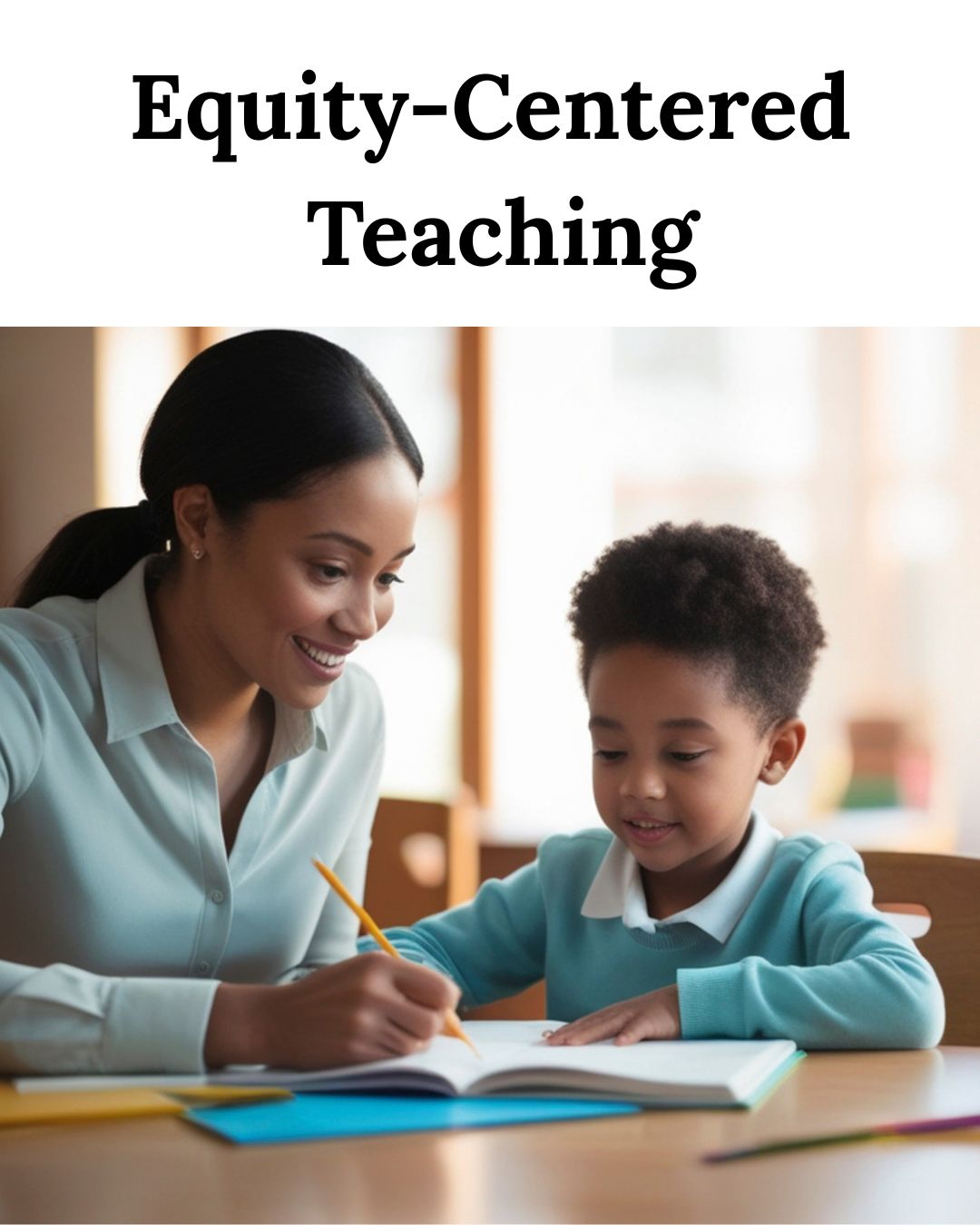
When it comes to equity in education it is important to understand that equity is not an add-on, it is not an initiative, and it is not a trend. Equity is the structural foundation that determines whether students experience opportunities on their educational journeys or are prevented from having successful educational journeys because of systemic barriers. Equality and equity are not the same thing. In many ways, they are polar opposites. Equality means everyone gets the same thing. While that that sounds like a good idea it is not. Students have different learning styles, different cultural backgrounds, and different abilities. Equality is a one size fits all approach to education is not a good idea. It does not give students what they need in order to thrive. Equality is good as an abstract notion; it is not the goal we should strive to achieve.
Equity is the goal we should strive to achieve. Equity is the thing that ensures that every student receives the resources, support, and opportunities they need to thrive in their educational environment. Equity means that students get what they need to succeed. Other students may get extended test time; other students may receive audiobooks instead of textbooks. This article will explore how equity becomes the foundation for success when schools intentionally create systems, relationships, and learning environments designed for each student’s individual success.
Understanding Educational Equity — What It Is and What It Is Not
One of the main problems with equality-based approaches in education is that they often reinforce existing disparities. This happens because all students are treated the same no matter what special needs or learning differences they may have. When equality is the keystone, everyone gets the exact same resources. When this approach is taken no care is given how to mitigate disparities. This means that any extra support or resources a student may need and fully learn a classroom lesson are not provided.
Example 1: Comprehension Worksheets
Take for example a 4th grade classroom where a teacher gives every student the exact same worksheet for reading comprehension activity. Students who are reading above grade will finish the worksheet quickly and be bored. Students who are reading below grade level will struggle with the worksheet, shut down, or guess the answers. Students who may speak English as a second language may have trouble accessing the vocabulary on the worksheet. Finally, students with specialized IEPs will not receive the scaffolds they need to complete the assignment. In this case the teacher treated everyone the same, but only a small number of students met the lesson’s learning objectives. The other students experienced frustration, disengagement, or failure.
If instead the teacher used an equity approach, advanced readers would have been provided with extension texts they would find challenging. She would have provided grade level texts for students who read below grade level. Students who spoke English as second language would have received a scaffolded worksheet with visuals designed for multilingual learners. Students with decoding challenges and IEPs would have been provided with audio supported versions of the worksheet. When equity is the standard, each student is able to work towards the same learning goal, but with the support that matches their need. This means engagement is increased and more students are able to demonstrate mastery of the subject matter.
Example 2: Communication from the School to Parents
Another example that highlights the difference between providing an equal experience and an equitable experience can be seen when a school sends all communication to parents through email. Families who do not have reliable internet connections will miss important school updates. Families who speak languages other than English may not understand the email and may be unable to secure appropriate translation services. Other families where parents may be working multiple jobs may not have the opportunity to check their email regularly. These parents also will miss important updates. Finally, parents who prefer text messages or phone calls will feel disconnected from the school. This example shows that equal communication does not mean equal access.
If on the other hand, a school chose to use an equity approach to communicating with parents, they would do things differently. For example, parents who preferred email would be able to receive email communications. Text messages could be used for quick updates for parents who prefer that method of communication. Phone calls could be used for urgent issues. Messages to parents could be translated for multilingual families. Parents without digital access could be given paper copies of important school notices. Finally, schools could employ family liaisons to support high need households in the school. If these types of approach were used, more families would receive information, understand expectations, and feel connected to the school community.
As these examples show there are four dimensions to educational equity. First, is access. Which looks at who gets what opportunities, programs, and pathways. The second dimension of educational equity is participation. This means looking at who feels welcome, included, and empowered to contribute. A third element of educational equity is support. Support looks at how schools respond to diverse needs, strengths, and barriers. The final element of educational equity looks at outcomes. Looking whether A few students experience success or whether all students experience success in the classroom.
There are a few common misconceptions about equity that must be addressed. First, equity is not lowering standards. Equity is not special treatment. Additionally, equity is not a one-time initiative. It is a continuous practice aimed at ensuring student success.
Why Equity in Education Matters — The Case for a Strong Foundation
Equity matters when it comes to achieving successful academic outcomes. Research shows that equitable practices improve achievement for all students, not just marginalized students (Davis, 2025; Miller 2025). Culturally responsive teaching, as well as differentiated instruction, support deeper learning by students. For example, when students who are historically marginalized are taught lessons that have characters, examples, and authors who represent their culture, those students feel part of the educational process. Further, when educators are able to differentiate instruction, students are able to interact with lessons where they are, this means they are more likely to learn what is being taught.
Equity is important because it builds stronger school communities. When students feel seen and valued, engagement increases. When equitable practices are used families become partners in the educational process rather than uninvolved outsiders. When educators teach with equity in mind, they experience more clarity, purpose, and alignment. This is due in part to the fact that the educators are reaching their students, Students are learning, and that provides educators with a sense of purpose and professional satisfaction.
Equity is also important because it supports long-term social and economic mobility. Schools are gateways to opportunity. It is education that makes it possible for a child to learn how to succeed in college or how to succeed in a career in the trades. Further equitable systems and schools help prepare students for civic life as adults. When schools provide equitable opportunities for students, those students feel that they have a place at school and in society at large. Those students are more likely to be successful at whatever they choose to do in life.
The Pillars of an Equity-Centered School System
Equity centered school systems do not just happen. They are the result of careful and intentional planning by teachers, administrators, school staff, parents and community members. There are five pillars of an equity-centered school system. These pillars are:
- Leadership that models equity
- Instructional excellence with inclusive pedagogy
- Data-informed decision making
- Family And Community partnership
- Safe, inclusive, and culturally affirming environments
Leadership that models equity
Equitable educational opportunities do not happen by accident. They happen when educators and schools make a decision to create an equitable educational environment for students. Leaders at the school set the tone for culture, expectations, and accountability. When school leaders make it clear that they want to provide an equitable educational environment, that type of environment is built within the school walls. It is important for school leaders to be transparent in their equity work. Leaders must communicate their desire to have equitable schools with all stakeholders. Leaders who are serious creating equitable schools will be sure to have equity centered professional development programs for teachers, school staff, and administrators.
Instructional excellence with inclusive pedagogy
Instructional excellence and inclusive pedagogy are part of what makes equitable educational opportunities possible. Providing an equitable educational experience does not mean that rigor is lessened. It is important for educators to have high expectations paired with high support for their students. Things like differentiation, scaffolding, and universal designed for learning help make equitable educational opportunities both possible and successful. Providing equitable educational opportunities for students also includes curriculum that reflects diverse histories, identities, and perspectives. These things are crucial to making students feel as if they belong in academic spaces. This is important because students who feel as if they belong have better educational outcomes.
Data-informed decision making
Data is an important part of providing students with an equitable education. Data-informed decision making can help educators create schools that are equitable for all students. It means using data in ways that illuminate patterns and not punish people. Disaggregating data to identify inequities is important. Disaggregation is important because it gives crucial information for decision making, without specifically identifying students. The important thing when it comes to using data informed decision is to be able to see the patterns inequities, and opportunities for improvement. Knowing the name and identifying factors for students is not critical to this process. Once the data is gathered, it is important for educators to create action plans to respond to what the data reveals. During this process, it is important for educators to think of what is best for the students and not be defensive about any problems the data may have found in the teacher’s pedagogy.
Family and Community Partnership
Important component equity in education involves recognizing that families are co-educators and co-leaders when it comes to their children’s education. Schools that are serious about equity and education take careful steps to remove barriers to participation including language, scheduling, and access barriers. When doing this work it is important to build trust through consistent, respectful communication with parents.
Safe, Inclusive, and Culturally Affirming Environments
The final pillar of equity in education involves providing safe, inclusive, and culturally affirming environments for students, families, and community members. Psychological safety is a prerequisite for learning. Students cannot learn effectively in environments where they do not feel safe. Equity-centered educational environments are safe environments for students. Equitable educational environments look at ways to use restorative practices instead of punitive discipline when it comes to student behavioral infractions. Finally, in creating an equitable educational environment teachers and administrators should strive to create classroom norms that honor identity, voice, and belonging for all students.
Practical Strategies for Schools and Educators
All educators should employ practical strategies in their work to create equity in education. This means they should have classroom-level strategies, school-level strategies, as well as district-level strategies. In the classroom it is important for teachers to build relationships through intentional routines. It is through routine that teachers can make clear to students that they are in a safe and equitable environment. Teachers should also take care to use student voice to shape instruction. This is important because it recognizes that students are more than recipients of education, they are partners in the educational process. Finally, teachers and classrooms should find ways to use flexible grouping and personalized learning pathways so that each student gets what is needed in order to succeed in the classroom.
There are several score level strategies that lead to equity in education. One strategy is to conduct equity audits and needs assessments. This work helps schools to identify what is needed, where it is needed, and what can be done to provide for the identified needs. Work needs to be done across the entire school to revise policies that create barriers to attendance, grading, and discipline. Schools should create equity teams or committees that have real decision-making power. Equity in education is not achieved simply by creating committees. It happens when those committees have actual power to make decisions, see those decisions carried out, and then do equity audits to evaluate the results the decisions.
On a district level, it is important for educators to allocate resources based on and need not tradition. Districts must take care to provide professional development opportunities for all district employees that are aligned to the district’s equity goals. This is important because districts must recognize that all employees must know about and work to support equity goals. Additionally, districts must realize that these types of professional development programs should not be one and done programs. Instead, they should be part of an ongoing plan to promote, support, and sustain the goal of having equitable schools throughout the district.
The Role of Educational Consultants in Advancing Equity
Educational consultants have a role to play in advancing equity in schools. There are three areas where educational consultants can share their expertise on the equity front. They include the following:
- providing clarity and structure
- building capacity across the system
- ensuring accountability and continuous improvement
Providing Clarity and Structure
One of the main things educational consultants bring to the table is clarity and structure. They do this by helping schools define what equity means within the context of that school. Educational consultants also help in schools by facilitating strategic planning and implementation of equity programs and policies.
Building Capacity Across the System
Educational consultants also help build capacity across the system. They do this by coaching leaders, teachers, and teams. Their work also includes supporting data analysis and action planning. The tools frameworks and resources that sustain progress designed by educational consultants are an important part of equity programs.
Ensuring Accountability and Continuous Improvement
In order for equity programs to have accountability and place for continuous improvement, it is important that progress is monitored with clear metrics. There must also be time for reflection, recalibration, and renewal.
Stories of Transformation — What Equity Looks Like in Practice
Equity becomes meaningful only when it moves from theory into practice. This is because talking about equity nd all its benefits is nice, but achieving is what matters in our education system. The following are three real world examples of what is when equity it is actually present in a school system.
Elementary School’s Redesign of Family Engagement
Let’s examine the example of Miller Elementary School efforts at creating a more equitable school. At this school, the data showed that families felt disconnected from decision making. This was problematic because the parents felt as though their voices did not matter and that the school did not have their children’s best interest at heart. Most school engagement events were poorly intended or dominated by a small group of parents and students. Communication at the school was one directional. It went from the school to the families. There was no reciprocal communication. Parents consistently expressed that they felt unheard or unsure of whether anyone paid attention to their efforts to advocate for their children.
Then came the change. With the help of educational consultants, the school conducted listening sessions with multilingual families to identify barriers to them feeling part of the school decision making process. The school shifted from having school designed “information nights” to co-designed engagement structures such as parent advisory circles and culturally responsive family workshops. Next, the school implemented two-way communication tools like surveys and text-based check-ins, and family liaisons. The staff were trained in culturally responsive communication and relational trust building.
Parents were invited to co-create school policies or event agendas. The result was that the family participation across demographics increased. This was seen in attendance and survey responses. Teachers noted improved home and School collaboration and more consistent student support. The school climate data reflected stronger trust existing between families and staff.
Shift from Punitive Discipline to Restorative Practices
Look at the Allen School District which moved from a punitive disciplinary program to a restorative justice centered discipline program. The Allen School District was plagued by high suspension rates, especially for Black and Brown Students. These students often felt targeted or misunderstood. Teachers felt unsupported in managing behavior Families expressed frustration with exclusionary discipline.
Then came the change. The district adopted a restorative framework grounded in relationships and accountability. This new framework provided professional development for teachers and staff on restorative circles, de-escalation, and trauma-informed practices. This framework created student support teams to intervene in conflicts and potential disciplinary matters. The district also implemented data reviews to identify disparities and to adjust practices as needed. Further under the new program the district partnered with community organizations to Support student well-being.
As a result, the district saw a measurable reduction in suspensions and office referrals. Student-teacher relationships were improved. Instructional time for students was increased as there were fewer students removed from class for disciplinary issues. Teachers and staff reported greater confidence in managing conflict.
Differentiated Instruction Close Learning Gaps
As a final look at how equity-centered practices can improve education Let’s look at Mrs. Scott 4th grade reading class. Mrs. Scott’s class had students with a wide range of reading levels. Students were often disengaged because the work was either too easy or too difficult. Traditional whole group instruction had left some students behind. Mrs. Scott was overwhelmed by the diverse learning needs.
Then came the change. Mrs. Scott implemented differentiated instruction using small groups Choice Board And scaffold task She used formative assessments to identify student strengths and needs. With that information in hand, she integrated culturally relevant texts and examples to increase engagement. She provided targeted support such as graphic organizers, sentence frames, and manipulatives. She added practices that built student agency through goal setting and reflection.
As a result of the work done by Mrs. Scott, her students showed measurable growth in classroom assessments and benchmarks. Student confidence and participation were increased. Behavioral issues were reduced as engagement improved. Mrs. Scott reported to administration that she felt more effective and supported in her work.
What These Equity Practices Reveal
These examples show that equity is not a single initiative. It is a systemic redesign of how schools listen, teach, and respond to student needs. When schools are able to center relationships, voice and differentiated support, students and their families experience real transformation. They begin to feel as if they are part of the education process. These examples also demonstrate the fact that equity can be measured, repeated, and sustained, when embedded into daily practice.
Challenges and Opportunities — What Gets in the Way and How to Move Forward
There are several common barriers to creating an equitable environment in schools and school districts. The first of which is resistance to change. Often teachers, staff, and administrators feel “if it ain’t broke don’t fix it.” Often, they feel that the way they have been doing things has given results that are good enough, so change is not necessary. Another barrier to change is limited resources or unclear priorities. Equity education is not prohibitively expensive but sometimes it is necessary to allocate funds to provide for professional development or new classroom resources. Another is that initiatives are fragmented or incoherent. Therefore, it is necessary for equity work to begin with clear plans that are SMART aka specific, measurable, attainable, realistic, and time-bound.
Opportunities for Growth
No matter where an educational organization is on its journey towards becoming equity-centered there are opportunities for growth. For example, data can be used to spark conversation. These conversations can lead more equity centered practices, a larger commitment to equity-centered teaching, or increased comfort equity in education. Growth can also occur when educators, families, and Community partners build coalitions. These coalitions can work together to improve equity practices, increase comfort, and make educational journeys more successful for students. Finally, it is important to recognize that growth can occur when all players celebrate small wins. Celebrating small can build momentum which in turn can lead to more wins.
Conclusion: Equity in Education Matters
In conclusion when it is important to recognize that equity is the foundation for strong, thriving schools. Equity is not a one-and-done initiative, policy, or program. Equity is a daily practice. The more teachers, staff, and administrators do equity work, the better they will be at that work. This article can be seen as a call for educators to promise each day commit to one step, one conversation, or one shift that moves their education practice in an equitable direction.
Davis, J. (2025). We love our kids too: Black parents supporting the academic success of their children in affluent, predominantly white school districts (Doctoral dissertation, West Chester University). West Chester University Open Commons. https://digitalcommons.wcupa.edu/all_doctoral/328/
Miller, E. K., Franco-Jenkins, X., Duncan, J. T., Reynolds Reddi, A., & Ward, C. (2025). Strengthening education through equitable and inclusive evidence-based teaching practices: A scoping review.Education Sciences,15(3), 266. https://dx.doi.org/10.3390/educsci15030266
20 Tips for Educators: A Powerful and Informative Series
Unlock Your Doctoral Success: Coaching & Resources That Work
Unleash the Fire Within: Maya Angelou’s Lifegiving Wisdom for Educators
We Love Our Kids Too: Black Parents Supporting the Academic Success of Their Children in Affluent, Predominantly White School Districts

About the Author
Dr. Janeane Davis is Founder and Principal Consultant at Janeane Davis and Associates: Educational Consultants. Her work is rooted in practical wisdom and strategic clarity—offering educators tools that honor both their brilliance and their bandwidth. She writes to make systems feel human and tips feel like rituals worth keeping.
One desk. Many drafts. Always refining
Click here to schedule an appointment with us.