
Imposter syndrome is common in academia. It can be thought of as a little voice inside you that says, “You are really not good enough. You got lucky to be here. What are you going to do when people find out you are not as smart as they think?” If you experience imposter syndrome you are not alone. Imposter syndrome happens when people who are qualified doubt their own qualifications. Imposter is a title we give ourselves, not a title given to us by others.
Exploring the Meaning
In academia you will find imposter syndrome in everyone from doctoral students to professors, to university presidents. There are a few ways that imposter syndrome shows up. One way is when a woman hesitates to speak up at meetings thinking she is not “smart enough” even if she is the most qualified person in the room. It may show up in a woman thinking she got a promotion because of luck or timing and not her skills. In graduate school it may show up as a woman accepted into a well-respected and competitive program thinking her admission was a mistake and she doesn’t actually belong. With first generation scholars, imposter syndrome shows up in doubts about one’s academic voice or fear that one lacks the pedigree of her peers.
Applications to Help One Battle Imposter Syndrome
One of the easiest ways to battle imposter syndrome is to admit that it exists and it is what you are experiencing. Name it. Literally say, “This is imposter syndrome.” Calling it what it is can help you break its grip. Another thing you can do is look back at your receipts. Take a few moments to look at your past wins, compliments you have received, and the credentials you have earned up to this point. These reminders of your talents, skills, and qualifications may serve to break you free from the grip of imposter syndrome. A third tactic is to reach out to other people in your position. Talk with them about imposter syndrome. Ask if they have ever experienced it or if they have ideas on how to battle imposter syndrome and win.
The following is a series of reflection activities you can use to battle imposter syndrome. Click here to download a PDF of this worksheet you can use whenever you need it.
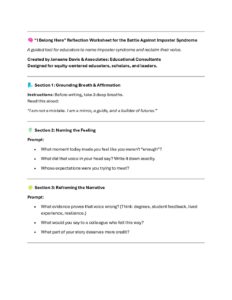
Reflection Worksheet for Educators Navigating Imposter Syndrome
Section 1: Grounding Breath & Affirmation
Instructions: Before writing, take 3 deep breaths.
Read this aloud:
“I am not a mistake. I am a mirror, a guide, and a builder of futures.”
Section 2: Naming the Feeling
Prompt:
- What moment today made you feel like you weren’t “enough”?
- What did that voice in your head say? Write it down exactly.
- Whose expectations were you trying to meet?
Section 3: Reframing the Narrative
Prompt:
- What evidence proves that voice wrong? (Think: degrees, student feedback, lived experience, resilience.)
- What would you say to a colleague who felt this way?
- What part of your story deserves more credit?
Section 4: Rituals of Reclamation
Prompt:
- What’s one small action you can take tomorrow to show up as your full self?
- Choose a mantra for tomorrow:
- “I belong here.”
- “My voice matters.”
- “I am qualified and evolving.”
- Or write your own: ___________________________
Section 5: Optional Add-Ons
- Color Code Your Confidence: Shade today’s confidence level from 1–5.
- Movement Moment: Did you stretch, breathe, or pause today? Circle one.
- Share Prompt: “What’s one thing you wish someone had told you today?”
Conclusion
It is important to recognize the fact that imposter syndrome is real. There is no point in pretending it does not exist. Educators may find it helpful to think of imposter syndrome as they would any other syndrome – something that is real and that a battle must be fought against it. When you battle imposter syndrome, use any and all tools you can get your hands and mind on. This is a battle you must fight to win. Losing is not an option. As you battle imposter syndrome journal and share your battle with others. Most of all, remember that you can win the battle against imposter syndrome.
Further Reading
The Best Educators Strive to Create Equity-Centered Classrooms
Unlock Your Doctoral Success: Coaching & Resources That Work
Unleash the Fire Within: Maya Angelou’s Lifegiving Wisdom for Educators

About the Author
Dr. Janeane Davis is Founder and Principal Consultant at Janeane Davis and Associates: Educational Consultants. Most of her writing begins at a well-lit desk where strategy meets storytelling and systems take shape around real lives. Her consulting work centers families, scholars, and institutions committed to equity—and she writes to bring clarity to complex questions, especially those often left unasked.
Desk light on. Pages open. Always listening.